Hendrik Tjeerts Knot, geb. 30 nov 1852, Stitswerd (gem. Kantens) ovl. 30 jan 1900, Kandiyohi (Minnesota, United States) (Leeftijd 47 jaar)
Verwantschap
geboorte
Moeder
Berta De La Ludvika Kraatz, geb. 7 jun 1864, Rügen (Pommern, Preußen, Germany) ovl. 10 aug 1934, Clear Lake (Skagit, Washington, United States) (Leeftijd 70 jaar)
1. Henry George Knott, geb. 16 mei 1910, Powers Lake (Burke, North Dakota, United States) ovl. 5 mrt 1998, Bremerton (Kitsap, Washington, United States) (Leeftijd 87 jaar) [Vader: geboorte] [Moeder: geboorte]
2. John Gordon Knott, geb. 14 mei 1912, Burke (North Dakota, United States) ovl. 22 jun 1998, Pasco (Franklin, Washington, United States) (Leeftijd 86 jaar) [Vader: geboorte] [Moeder: geboorte]
3. Norman Philip Knott, geb. 11 mrt 1917, Burke (North Dakota, United States) ovl. 29 jan 1978, Olympia (Thurston, Washington, United States) (Leeftijd 60 jaar) [Vader: geboorte] [Moeder: geboorte]
▼ “Any Work I Could Get”
George Knott was born near the highly urban context of Chicago, Illinois but spent most of his life in rural or semi-rural areas, not necessarily out of choice. He once said that he “took any work I could get”, and that plus his efforts to acquire land, the land that he likely saw as a form of security, provide a framework for much of what happened in his life.
▼ Chicago and Minnesota
George was born 17 June 1885 in Maywood, Illinois, a suburb west of Chicago.[23][1][20] Two years later the family was living in Melrose, just eight miles north, where George’s oldest sister was born. Then, when George was about three, his family moved to Lone Tree Township in Chippewa County, Minnesota, where his father felt called to serve as a lay missionary.
About the time George was five the family moved again, to Perham, Ottertail County.[13] Here, George's father served several years as a lay, or supply, minister to the Methodist Church. Because the pay for supply ministers was minimal, the family was dependent to some extent on charity, and George's youngest sister talked in later years about getting clothes for the family from a barrel sent them by the Missionary Society.[26]
When George was about ten, the family returned to Raymond, in Kandiyohi County, where the extended family was settled. Then George's father died, leaving George the oldest male in the family at the age of 14, with five younger siblings. An unmarried uncle came to live with the family, possibly to help with whatever farm chores needed attention.[14] George's mother had no experience with farming. Instead, she apparently worked as a midwife or helped nursing the sick, and the older children helped out as best they could. George worked out for the neighbors so that he didn't have to be home for board, and to pay for his clothing and other expenses. One year George tried raising purebred chickens, even investing in an incubator, but presumably that experiment proved less successful than hoped, as it was not repeated.[26]
George's mother had a cousin living near Chicago who offered to pay for George's education, and George may have spent a year in Chicago attending school. His youngest sister believed that he attended the Moody Bible Institute,[26] but that may have been what their mother wanted. The Institute has no record of George ever attending.[27] What George wanted was to be a lawyer. George's mother, however, considered law unfit work “for a God-fearing man. She said all lawyers were crooked, and she didn't want her son to be a lawyer”.[26] So George went west, probably with others from the area of Raymond, perhaps first to Denver, Colorado,[28] but eventually to northwestern North Dakota.
▼ North Dakota
In North Dakota George continued to work at any job he could get, including coal mining.[23] But the real attraction of North Dakota for George was probably the opportunity to own land, something his father had never done. Land for much of the rest of the family had provided the basis for financial security, however hard the work was. When George applied for a homestead, in the fall of 1905,[23] he provided a covering letter stating that:
"I am a native born citizen of the United States, and that I will be 21 years of age June 17, 1906; that my father died about six years ago without leaving any means of support for my old and feeble mother and three younger brothers and sister[29]; that I have a brother 11 years and one 14 years of age and a sister 9 years of age; That I am the head of the family in that I have furnished all the means of support for my old and feeble mother and two young brothers and sister, and that I have furnished the exclusive support for the family ever since my father died six years ago to the present time and that I must and will continue to do so for the future, that my mother, brothers and sister have no other means of support except myself; that I am the head of the family in all that goes to furnish a home and neans [sic] of support for my old and feeble mother and brothers and sister.”
Since George's mother was almost universally described as "formidable" by those who knew her,[30] the statement that she was "old and feeble" may have been formulaic, emphasizing his need for the land.
Like others who homesteaded, George worked to improve his claim, building a small house (eight by 12 feet) and a larger barn (sixteen by thirty feet), and breaking soil for crops. He also continued to work off the farm to earn money for expenses and to send home to his mother. During the summer he worked as a school teacher, coming home for the week-ends.[23] He also seems to have been active in the local community, as he was apparently a school trustee who helped his sister Ethel get a job as a teacher one summer during this period.[26] This may also have been how he met his future wife, Neva, for she, too, worked as a school teacher before their marriage.[31]
George continued to work part time off the farm after his marriage. His occupation in the 1910 census is listed as bookkeeper for the local bank,[15] the bank owner being one of George's neighbors. For all that he was hardworking and involved in the community, George seems to have had a somewhat romantic streak, as well. He was quite proud of the mustache he grew (although his wife hated it),[31] and in a photo of him taken with his plow and team during this time period, his hat has a definitely rakish appearance.
Nor was George without a temper. His wife Neva suffered complications and nearly died giving birth to their youngest son. The attending doctor was drunk, which did not help matters. George waited until mother and child were safe, then took the doctor outside and beat him up, exacting a rough and immediate justice. [31]
According to family stories George and Neva continued to live on their homestead until the winter after their youngest son was born, when they sold the farm to a local rancher and spent that winter working for the rancher. George worked as a cow or stock "hand", and Neva worked as a cook. Come spring, they left North Dakota , their youngest son still in diapers, and travelled by train to Skagit County in Washington. [31] This would have been the winter and spring of 1917-1918.
According to documentary sources, however, the farm was sold in June 1914.[3] It's possible that the family needed the money to pay medical expenses, as Neva mentioned one time that one of her older sons had to be taken to the hospital in Minneapolis, Minnesota when young, although she refused to elaborate. [31] Whatever the reason, George did later investigate the possibility of making a second homestead claim, but because he had sold his first claim, he was ineligible.[23] It's also likely that the journey to Washington state was made in at least two stages, as when George's youngest brother Carlton wrote to their mother in 1918,[32] he said he did not know where George was, whether he was in ”Sand Point or Kootinia”, both places in Idaho. By September of that year, however, the family was in Sedro-Wooley, Washington, where George worked for the Carnation Dairy Company.[1]
▼ Washington
In Washington, George and Neva soon bought a house in the town of Sedro-Woolley.[4] But George wanted more. He is said to have purchased land to start a dairy farm, taking out a bank mortgage to do so. Interest rates on the mortgage were said to be predicated on a strong dairy cream market. Shortly after taking out the mortgage, the bottom fell out of the dairy market.[33]
Documentary records tend to bear out the family story. Spurred by the war, the agricultural economy in the Skagit Valley was booming when George arrived. Dairy men, among others, were challenged to meet wartime demand,[34] as George clearly would have known, working in the dairy industry. George did buy land for a farm.[5] The farm land was in the hills above Clear Lake, less suited than the valley itself for agriculture. Straddling a logging road known as the John Day Creek Road, (or Old Day Creek Road as it is now known), it, too, was purchased with a private mortgage.
Unfortunately, George’s purchase was not well-timed. With the war ended, the dairy market collapsed and the economy of the Skagit Valley went into a serious recession.[35] Either in order to help make payments on his mortgage or to buy a house in town, in February 1922 George sold part of the farm, with a private mortgage, to his brother Ray in Montana, who had a well-paid, steady job.[5] Ray in turn, seems to have sold his share of the farm about 1930, again on private mortgage, with the sales being finalized in October 1939.[36]
On the farm, the family lived in a log house, possibly on that part of the land purchased by his brother Ray. In the late 1930s George built a new frame house about a half-mile up the road. The log house burned down in the 1950s and no longer exists. In the meantime, George seems to have re-negotiated the mortgage for the remaining portion of his land in 1928, with the mortgage taken over by the First State Bank of Clear Lake and paid in full in 1933.[5]
George continued to believe in property ownership, for in April 1922 he purchased a house and lot in Clear Lake.[6] Presumably the property was sold at bargain prices, as it had been owned by the Clear Lake Lumber Company, previously the economic mainstay of the area. But lumber companies, like farmers, were suffering from the recession. Then a fire destroyed the company mill in 1921. After at least one abortive attempt, the mill finally re-opened in February 1929, only to be hit by the failure of Wall street later in the year.[37] George resold the house and lot late in 1925, when it looked like the mill would re-open. He assumed a private mortgage, but the new purchasers were unable to make the payments on the mortgage and defaulted in January 927, presumably because the mill failed to remain open. For once, fortune was on George’s side, as the Clear Lake Lumber Co. was involved in legal battles to settle its own debts and full ownership of the town lots was granted to George by the courts for the amount he had already paid.[6]
By this time other members of George’s family were congregating in Clear Lake. His mother and step-father had arrived early in 1920, purchased a house and lot on 17 May 1920, then a farm along the Lake in December of that year. George’s sister Ann and her husband arrived in 1922, and his sister Ethel and her husband about 1929. Who, if any, of the family occupied the house is unknown, but it was sold, this time successfully, in June 1930. [6]
The Great Depression of the 1930s hit the Skagit Valley hard. Men lost their jobs, companies failed, hobo camps grew. As in other areas of the country, public construction of roads, bridges and other infrastructure projects often provided the only form of economic relief. .[38] George was among those who worked at road building, and it was to this period of his life that he referred when he said that he took "any work I could get”.[39]
The 1940s brought some measure of prosperity to the Skagit Valley, although little of it reached the town of Clear Lake. Logging continued to be the major economic activity, and George worked as dynamiter in the logging camps while continuing to farm until his retirement. He was active in the community, belonging to the local Grange,[11] and may have been a School Board Trustee.[31]
▼ Retirement
In 1950 George retired, selling the farm and moving to Sedro-Woolley where one of his son's lived. When that son moved to Kennewick, Washington, George and his wife Neva followed, and then again to Walla Walla, Washington, where he died on 22 January 1962.[2]

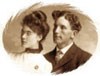


 1885 - 1962 (76 jaar)