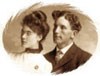
Berta De La Ludvika Kraatz, geb. 7 jun 1864, Rügen (Pommern, Preußen, Germany) ovl. 10 aug 1934, Clear Lake (Skagit, Washington, United States) (Leeftijd 70 jaar)
[edit]
▼ Coming to America
Hendrik Tjeerts Knot, first child of Tjeert Knot and Imke Pesman, was born 30 November 1852, in Stitswerd, Groningen, Netherlands.[1] When he was about eighteen he left home to work as a farm laborer, much as his father had done before him, except that Hendrik went to Warffum,[13][14] about six miles away. After about three years as a farm laborer, at the age of twenty, Hendrik went to America, to the United States.
Hendrik arrived in Chicago sometime in 1872. He was not the only one of the family to emigrate. His father’s cousin, Klaas Knol, also from Warffum, arrived in New York on the 18th of April of that year. Hendrik and Klaas were followed by Hendrik’s family in 1873, then by more Knol cousins from Warffum: Klaas Knol’s nephew, also Klaas Knol, in 1880; Klaas’s brother Tjeert Knol in 1881; and the rest of the Knol family, including parents Jan and Antje Knoll in 1882. They all settled initially in Chicago’s West Side, as part of the Groningen community,[17] and while we have no records, seemed to remain in regular contact with each other.
[edit]
▼ Chicago
After the Chicago fire opportunities for work were good.[18] Henrdrik’s cousin Klaas, now known as Nicholas, worked as a laborer for several years, eventually becoming a painter.[19] Henry, as Hendrik became known, probably also worked initially as a laborer, and at some point also may have worked as a painter.[20]
By 1880 Henry was working as a domestic servant for a lawyer, Horace Wade.[3] The Wade household included two other servants, women from Ireland and Germany. Henry’s sister Jennie also worked as a servant in 1880, and their sister Grace worked as a servant before her marriage.[21] Domestic service provided employment for great numbers of immigrants during this period, and for women, at least, working conditions were considered better than they would have been at home.[22] Perhaps the same was true for men, as well. In any event, Henry and his sisters were simply following the same pattern as their parents, only in a new land.
In at least one respect, Henry’s life took a very different turn from that of his parents. On 3 October 1880, he became a member of the Moody Church. From the time of Lambert Garbrants, in the late 16th century, the Knotts had been members of the Dutch Reformed Church, a calvinist church and the national church of The Netherlands. The Moody Church was an evangelical church. The difference between the two churches was expressed by Henry’s sister Grace, when she explained that it was only in America that she accepted Christ and became a Christian. "She heard it preached that sins must be forgiven, and souls redeemed through Christ, but, she said, 'I do not feel consious of any sins that need forgiveness.' So, she related, -- 'I prayed to God, that if this were so he would let me feel my sins. And Oh, how he made me feel them!' Then she realized her need of Christ, and accepted him as her Savior; and continued a faithful Christian during her long life time."[23] Henry apparently had a similar experience, as Grace’s words are echoed by Henry’s youngest daughter, who said that "Papa became a Christian" after listening to Moody’s sermons.[24].
Henry may have moved about the time he joined the church, to the outskirts of Evanston,[10] and may have met his wife Bertha Kratz there. Bertha had come to the Chicago area from Germany with her parents in 1872, and in 1880 was working as a servant in Evanston. According to their daughter, Henry and Bertha met through the Moody Church.[25] They were married in the New England Congregational church in Chicago, however, on the 21st of September 1882, perhaps because Bertha did not join the Moody Church until April of the following year. Soon after they moved moved west of Chicago, to the vicinity of Maywood,[11][12] possibly taking over the farm Henry’s father had rented. Here, their first son, George, was born 17 June 1885, just over eight months after Henry obtained his citizenship.[4], followed by their daughter Anna on 19 April 1887.
[edit]
▼ Lay Minister
But Henry did not want to be a farmer. He wanted to be a missionary. Family stories say that Henry attended the Moody Bible Institute, but it did not open until 1886 and has no record of Henry’s attendance.[26] More likely, Henry was inspired by Dwight Moody’s call for "gap-men to stand between the laity and the ministers; men who are trained to do city mission work. Take men that have the gifts and train them for the work of reaching the people." Rather than returning to the city, however, Henry and Bertha moved with their two young children to Minnesota, to Clara, in Chippewa County, less than 15 miles from Henry’s parents in Kandiyohi County. In May of the following year, 1889, their daughter Ethel was born in or near Clara. According to stories told by Henry's daughter, Henry may have preached independently at first. “In the summertime they'd hold service outdoors under the trees, and if it rained they'd find an empty barn somewhere for the crowd to get into and hear the services. They often preached in railroad stations or in saloons or anyplace where they could get a crowd together to preach to.”[25]
In 1890 Henry became a “supply” or lay minister for the Methodist Church. As such, he was called on when the Church did not have an ordained minister to fill a vacancy. During the years 1890 through 1893, he was based in Willmar, although he and his family lived on his sister Jennie’s farm near Raymond.[20] Methodist services had been held near Raymond since 1880, again wherever it was possible to organize a meeting; sometimes in a private house, sometimes the train station in Raymond or the office of a grain elevator, sometimes, presumably when the weather was nice, in a farm orchard. Henry had visited whenever possible. The Raymond Congregation was organized in March of 1890, with fourteen members, including Henry and Bertha and Henry’s brother William.[27] About a year later, Henry and Bertha had another son, named Raymond Wesley, because he was the first boy born in Raymond and the first boy baptized in the new church.[25] Henry conducted services in Raymond for several years and, beginning in 1891, began to “fill in” for churches in Perham and New York Mills in Ottertail county, about 135 miles to the north.[28] Towards the end of 1893 the family moved to a farm about half way between the two, where their son Carlton was born on the 4th of October.
[edit]
▼Return to Raymond
They were able to stay only a few years before family called them back to the neighborhood of Raymond. Henry received a letter from his sister Jennie, who
“had married a farmer there in Holland Township, . . . saying that her husband was very sick and wondering whether he would be willing to stop his preaching for a year or two and come and run the farm for her because he couldn't handle it. And Papa said he would. They were, well it took a little while to settle things where he was and with the church to get a leave of absence so that he could go. . . . But before they got down there, Uncle Albert had died. And two days after he was dead Aunt Jenny had a little boy, and they called him Albert. And so Papa came down there to run the farm for her. Now he didn't know much about farming, but in those days anybody could be a farmer. It didn't take much knowledge. So he came down and ran the farm for Aunt Jenny. . . . And then she had five step-children, three boys and two girls and they were all the way from ten to about twenty-one, twenty-two years old. And they probably knew a lot more about farming than Papa did, but they would take orders from him. So he ran the farm [in Prinsburg] for about two years there.”[25]
Henry did more than run the farm. He continued to be involved with the Raymond Methodist Church, becoming a Trustee in 1895,[27] and also served as a Justice of the Peace.[9] And he and Bertha had two more children, Alvina on 3 May 1896, and Vernon on 31 July 1897, almost six months after Henry’s father died in February. His daughter, Alvina, remembered the good times as a small child, including a time when she, Vernon and a cousin were playing.
“And we were having a good time, laughing and having a good time when all of a sudden Vernon choked on a peanut. It had gone down his windpipe. And they tried everything to try to get that peanut up, but they couldn't, so they called the doctor. In those days, calling the doctor was something out of the ordinary, but they got a doctor. From thirteen miles away the doctor hadda come with horses, and it was in the wintertime, right after Thanksgiving. And when he came, he couldn't do anything, so he called another doctor in for ________, and they knew what happened: they peanut had gone down the windpipe, and sometime for days the baby would play around just perfectly normal and then all of a sudden he'd get a choking spell. Well, he lived that way for six weeks, and then he died. And so Mother had lost her baby.”[25]
Vernon died on 3 January 1900. Worse was yet to come. Henry himself died less than a month later, on 30 January of the same year.[6]
“Father was getting ready, the grain ready to seed in the spring, and he was running it through the tanning mill. Now I don't know whether you know what a tanning mill is, but it's a machine-in those days it was run by hand-and it had several screens in it. They'd pour the grain in the top, and the small weed seeds fall through the screen and it makes a difference what grain they're cleaning what screen they use. And there's a bellows in there, and it has a strong wind and it blows the dust and dirt and the light hulls of grain and things away. Supposedly when it comes out the other end, the grain is clean and ready for seeding with no weed seeds in there. What happened that Father had a boil on his cheek. Well, he had a full beard and a boil on his cheek. And in cleaning the grain, some of the dirt from the grain got into his beard and into his boil and started an infection. Well, they, they called the doctor. He lanced it, but the infection spread, and Father got blood poisoning. Well they had a couple doctors. They had no x-rays then, and they didn't know what to do. So Father died.”[25]
Henry’s death left a grieving young family, little in the way of material well-being,[29] but a life “Rich in good works.”[30] He was buried in the Roseland Cemetery, the same cemetery as his father, where the marker on his grave reads:
Here now above my weary soul
In seas of heavenly rest
Not a wave of trouble rolls
Across my graceful breast



 1852 - 1900 (47 jaar)